
Weight classification of transfer vehicles
products |
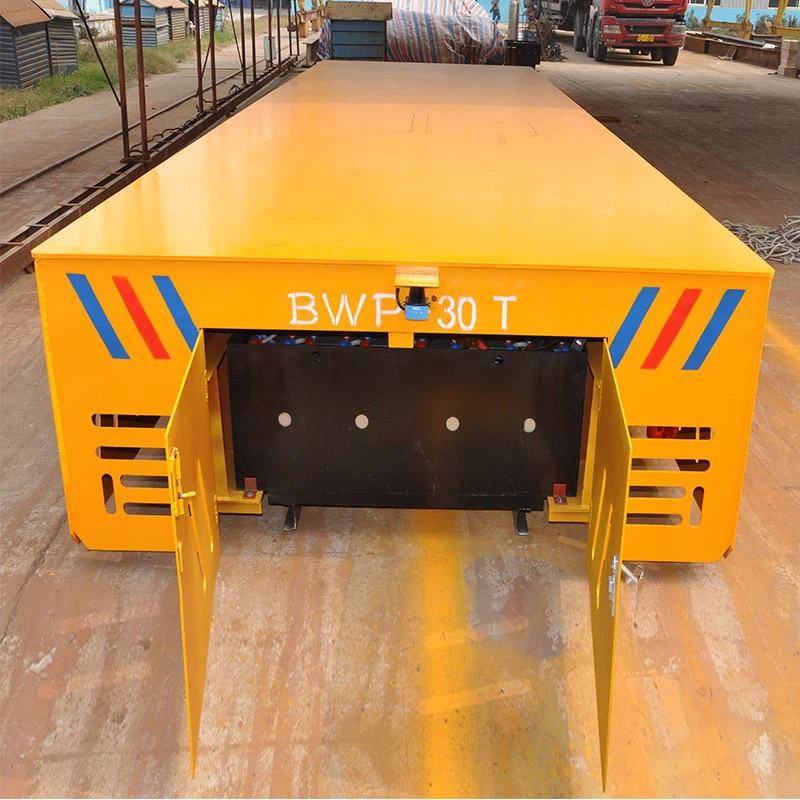 |
 |
 |
Product Type |
Light material transfer carts(with a load capacity of 0-5 tons) | Medium sized material transfer carts (with a load capacity of 5-20 tons) | Heavy material transfer carts(with a load capacity of 20 tons or more, including super heavy 50 tons or more) |
Bearing components |
The fork or bearing platform adopts a "lightweight grid structure", which not only reduces its own weight but also facilitates observation of the material placement status; Some models are equipped with an "automatic leveling device" to ensure that the platform remains level even on slightly uneven surfaces such as workshop thresholds and slight slopes, preventing materials from slipping off. | The load-bearing platform adopts "patterned steel plates" (anti slip) or is covered with "rubber pads" (to protect the surface of materials, such as car body transportation); Some models are equipped with a "hydraulic lifting system" (lifting height of 0.3-1.5 meters), which facilitates docking and loading and unloading with shelves and trucks; The axle adopts a "dual axis or three-axis design" to distribute the load pressure, and the tires are selected as "industrial grade radial tires" (with a load factor of 10-16 levels), with a wear life of up to 30000 to 50000 kilometers. | The bearing platform area can reach 10-50 square meters (such as flat heavy-duty vehicles), or equipped with "special fixtures" (such as "arc-shaped clamping arms" for steel coil transfer vehicles and "hydraulic support legs" for ship section transfer vehicles); To achieve precise positioning, some models are equipped with a "hydraulic leveling system" (adjustable height ± 300mm, horizontal error ≤ 0.1%) or a "track guidance device" (traveling along a fixed track, positioning accuracy ± 2mm); Use "giant engineering tires" (diameter 1.5-2.5 meters, level 20-32) or "track type walking" (suitable for soft ground, such as mines) for tires |
Power configuration |
Mainly powered by 48V/72V low-voltage lithium batteries, the motor power is mostly 1.5-5kW, the torque output is gentle, and it supports "stepless speed regulation". The impact during start stop is small, avoiding damage to light and brittle materials such as glass products and electronic components; The range is usually 80-150 kilometers, matched with a small charging station (compatible with 220V household voltage), and can be fully charged after 4-6 hours of charging. | Electric vehicle model: equipped with 120V/240V high-voltage lithium batteries, motor power of 10-20kW, range of 120-200 kilometers, equipped with "fast charging piles" (380V industrial electricity), charging for 2-3 hours can replenish 80% of energy, suitable for indoor or environmentally demanding scenarios (such as automotive parts factories) | Hybrid vehicle models (such as those used in ports): adopt "diesel engine+electric assistance", use electricity during low-speed operation (to reduce emissions), use oil during high-speed driving (to enhance power), and some ultra heavy vehicle models (such as those weighing over 200 tons) adopt "external power supply+motor" (requiring the laying of tracks or cables, such as steel billet transfer vehicles in steel mills). |
Suitable Venues |
Suitable for electronic/3C manufacturing workshops (such as Parfit electric pallet truck for distributing circuit boards and other components), food/pharmaceutical industries (such as electric tractor for transporting pharmaceutical raw materials), and small e-commerce warehouses/convenience stores (such as manual hydraulic transport vehicles for package handling), meeting the needs of small space, light load, high cleanliness or low-frequency handling | Covering the manufacturing/assembly of automotive parts (such as the Parfit medium-sized electric transfer vehicle transporting the body through magnetic stripe navigation), mechanical processing/heavy parts factories (such as the fuel powered medium-sized tractor transporting the machine bed), and large e-commerce/third-party logistics warehouses (such as electric medium-sized forklifts or tractors transferring whole loads of goods), meeting the needs of general load capacity and multi scenario adaptation | Serving the steel/metallurgical industry (such as transporting steel billets with 80 ton track type transfer vehicles), shipbuilding/marine engineering (such as moving ship sections with multi axis hydraulic flatbed trucks), mining/infrastructure (such as transporting generator sets with 300 ton track type transfer vehicles), and special transportation/emergency rescue (such as transporting prefabricated beams or rescue equipment with mobile flatbed trucks), suitable for special heavy loads, extreme environments, or temporary heavy load scenarios |
Case Sharing
Misconception
Blindly pursuing "high load capacity" while neglecting site compatibility and wasting costs
Typical Scenarios
An electronics workshop routinely transports 3-ton circuit boards. To "leave room for growth," they selected a 10-ton medium-duty transfer cart. However, the workshop's 1.5-meter-wide aisles couldn't accommodate the 2-meter-wide cart body. Frequent reversing adjustments were required, resulting in transfer efficiency 40% lower than the original 3-ton light-duty cart. Similarly, a small mold factory followed trends by selecting a 15-ton model, incurring an extra ¥30,000 in frame reinforcement costs-yet never utilized over 8 tons of load capacity in three years
Core Issue
Confusing "safety redundancy" with "blind overloading": Light-duty transporters feature narrow bodies (≤1.2m) and low-load frames designed for narrow aisles and light loads; While medium-duty vehicles' reinforced tires and crossbeam structures can handle heavier loads, they occupy more floor space and increase procurement costs
Avoid Pitfalls Guide
Select based on "Daily Maximum Load + 10% Redundancy": For example, choose a 5-ton light-duty vehicle for daily 4-ton loads-no need to upgrade to medium-duty. Only consider a 10-ton medium-duty vehicle when loads consistently range between 6-8 tons.
First measure key site dimensions: Light trucks require aisle width ≥ vehicle width + 0.3 meters. Medium trucks require ground load capacity ≥ 8kN/㎡ (approx. 800kg/㎡) to avoid situations where "the truck can't enter or be used after purchase."